This is such as biggie that it really needs it's own post. The TARDIS take-off sound is one of the few sound effects that's now classified as music for copyright reasons. It's basically the sound of the bass strings of a piano scraped with a door key, slowed down, sped up, repeated echoed and fed back on itself until it became a high pitched whine heading off into infinity.
The TARDIS sound is an icon. It can't be used to convey any other event other than a particular type of time-machine materialising and dematerialising in a particular programme. If it was used for any other event, any viewer familiar with Doctor Who at any time will reject the sound. Like Tarzan, there's no way to repurpose the sound for any other use. The particular combination of bombastic bass notes and top end bleeps and whistling is also the sort of sound no one would have the guts to use for the first time these days. In short, it's a remarkable achievement in sound design.
Here is the first TARDIS dematerialisation from the very first episode in 1963 and was the few, if not only occasions where the full sound effect was heard.
The thud should be familiar to anyone who's ever bumped their legs into a piano whilst playing.
Throughout the 60's and early 70's, the series experimented with how the sound was presented. The sound would audible within the TARDIS on some occasions, not at all on others, variations made and eventually a dedicated landing sound (the take-off in reverse). By the mid 70's it had more or less stabilised to no sound audible inside the TARDIS and a specific take off and landing sound heard outside. The new series has shaken up that standard but as it's a new series for a new audience, it works best if you treat it as a separate entity in the same universe (for example: Classic Trek and TNG).
It's actually pretty good consistency for a series that has racked up 32+ seasons. I'm one of those pedants who gets annoyed at the changing gun sounds in Star Wars and that's inside of 12 hours of movies.
Note: Doctor Who has always been very popular but has always brought out the inner nerd in many of us. When I started making little movies on videotape in the 80's with Star Wars figures, it was Star Wars figures wrapped in different coloured electrical tape to make Doctor Who characters. So it comes as no surprise to me in the YouTube era with Doctor Who once again popular with people of all ages that the internet is clogged with Doctor Who fan videos and 90% of them are someone's attempt at a TARDIS take-off. It's very hard to find an actual video of the TARDIS from the series.
Showing posts with label Radiophonic Workshop. Show all posts
Showing posts with label Radiophonic Workshop. Show all posts
Friday, 27 January 2012

Thursday, 26 January 2012
HITCH-HIKER'S GUIDE TO THE GALAXY
The Hitch-Hiker's Guide to the Galaxy started off as a BBC Radio series in 1977 and one of Douglas Adams' stated goals was to have the series not sound like every other radio comedy of the previous 50 years. To that end, the BBC Radiophonic Workshop were drafted in, crafting a great number of classic sound effects for the radio series and later iterations on record and television.
This is the sound of the Hitch-Hike's Guide itself being used. If my smartphone made this sound every time I looked up IMDB to see how old an actor was, I'd shoot myself but as a sound to denote when the guide itself was in use on a radio series it is an excellent piece of sound design. You can't mistake the sound of the guide for anything else. It has a clunky machinery feel that was in tune with how people saw computers in the 1970's (ie corporate mainframes with large reel-to-reel tapes whizzing around), but stands out even in an era where computers make little sound that user experience designers haven't deliberately specified. The sound is funny without saying "hey, I'm funny and amusing." But then, it was from an era were something that sounded somewhat like but not actually flatulence was funny. There's a lot of almost scatological but not really sounds in Hitch-Hiker's.
Marvin the Paranoid Android had that fantastic movement sound made of tape loops but the real genius was in the vocal treatment the character was given. You of course need Stephen Moore's fantastic vocal delivery accompanied by a harmonizer (an early hardware pitch-shifter) but we have an effect that conveys a manically depressed android yet allows the dialogue to be (mostly) intelligible. Alan Rickman's delivery in the film was great but I'll always have Stephen Moore's voice in my head.
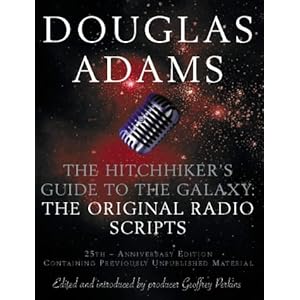
Many moons ago, a script book of the first two radio series was released with each episode accompanied by production notes that occasionally went into how the sounds were made. A great deal of tape loops and flanging went on in the creation of some of these sounds. And splicing. Oh, did they splice. And an ARP Odyssey synth. After Adams' untimely death, the BBC adapted the 3rd, 4th and 5th books into radio plays but without the Radiophonic Workshop (which has been long gone). The sound design is fine but somehow missing that zing. You always appreciate things when people work harder to achieve them.

Though the technology used to create these sounds has moved on there are still some great bits of advice in the notes. For instance, if you are recording voice artistes who are meant to speaking over the top of a noisy event, e.g. in a club or a battle, give them music in their headphones.
This is the sound of the Hitch-Hike's Guide itself being used. If my smartphone made this sound every time I looked up IMDB to see how old an actor was, I'd shoot myself but as a sound to denote when the guide itself was in use on a radio series it is an excellent piece of sound design. You can't mistake the sound of the guide for anything else. It has a clunky machinery feel that was in tune with how people saw computers in the 1970's (ie corporate mainframes with large reel-to-reel tapes whizzing around), but stands out even in an era where computers make little sound that user experience designers haven't deliberately specified. The sound is funny without saying "hey, I'm funny and amusing." But then, it was from an era were something that sounded somewhat like but not actually flatulence was funny. There's a lot of almost scatological but not really sounds in Hitch-Hiker's.
Marvin the Paranoid Android had that fantastic movement sound made of tape loops but the real genius was in the vocal treatment the character was given. You of course need Stephen Moore's fantastic vocal delivery accompanied by a harmonizer (an early hardware pitch-shifter) but we have an effect that conveys a manically depressed android yet allows the dialogue to be (mostly) intelligible. Alan Rickman's delivery in the film was great but I'll always have Stephen Moore's voice in my head.
Many moons ago, a script book of the first two radio series was released with each episode accompanied by production notes that occasionally went into how the sounds were made. A great deal of tape loops and flanging went on in the creation of some of these sounds. And splicing. Oh, did they splice. And an ARP Odyssey synth. After Adams' untimely death, the BBC adapted the 3rd, 4th and 5th books into radio plays but without the Radiophonic Workshop (which has been long gone). The sound design is fine but somehow missing that zing. You always appreciate things when people work harder to achieve them.

Definitions and History
What makes a sound iconic? What makes anything iconic? I would argue you can't make a sound iconic, it becomes one organically over time and is recognised as such. Sometimes an iconic sound becomes a source of humour, like the 'Bionic' sound effect from the Six Million Dollar Man or the "wilhelm" scream. Some are so identified with one particular use you can't use it for any other application. The Bionic sound was also used extensively in cartoons, but try using the Tarzan yell for anything other than a man swinging on a vine and see how far you get.
As a sound designer, I often find that I am disappointed with a lot of modern sound design in that sound designers try too hard to go for spectacle or exaggerated realism. They spent a lot of time processing the sounds with compressors, aural exciters and spacial effects that they end up making very impressive, but ultimately bland and forgettable sounds. Or even worse, just dump any impact sound through a sub-woofer. It's often a treat when someone uses a flanging effect these days. How often do you go to movies these days and remember a cool sound effect? Even big budget videogames, which in many respects had the most scope for creative effects, have started to feature sound design that is utterly polished by more or less forgettable.
There are certain milestones the sound design from movies, TV and games. I would argue that the vast majority of new and iconic sounds has come from science fiction or fantasy sources but I'd like to define in this post some of the movies, TV and games that have made their sound effects and sound design part of our culture.
 Cool-sounding sound effects have been with us for a long time. When radio was the dominant medium, full of dramas and comedies, a sound effects man would be providing foley effects off to the side of the stage. It was with the advent of talkie movies, both features and shorts where the sound could be edited and manipulated with relative precision, that things really took off.
A lot of iconic sounds eventuated from the likes of Three Stooges and Looney Tunes shorts, often created using similar methods to those in radio. As recording equipment improved, particularly with the introduction of tape recorders in the late 1940's, we saw more sounds created through manipulation of real world sounds. So we had a great spurt of new sounds from the 40's and 50's but things did appear to stagnate in the 60's with the same sounds appearing over and over. Was it because a heavily unionized industry of Hollywood technicians had closed the doors to new blood? Star Trek on television aside, there weren't too many creative sounds coming out of the US industry.
The UK in the late 1950's had seen the establishment of the BBC Radiophonic Workshop which was to provide BBC radio and television productions with music and special sounds that couldn't be obtained from other sources. Mainly concerned with music, the 1960's did provide an outlet for creative sound effects at the Radiophonic Workshop with a new science-fiction series Doctor Who. The Radiophonic Workshop created a great number of sounds for that series (and others) that will be covered in future posts.
The 1970's continued the overall creative stagnation in movie sound design. How many times did we hear the same thunderclaps, the same explosion and gunshot sounds, the same wobbly telephone. Walter Murch moved sound design along with THX 1138, and gave the field a name at last but it was Ben Burtt's work on the first Star Wars that showed you didn't need to rely on the same dozen sound effects on every programme. Cartoons provided a great deal of scope for creating new sounds even if they didn't always have the time to create whole new libraries. The odd gem escaped such as the famous sound of the Transformers changing or proton packs from Ghostbusters. As more Japanese cartoons were being translated into English, we were exposed to a whole new series of sound effects created by Japanese sound editors.
And videogames happened. Although sounds were mainly generated by a fairly weak chips in arcade machines, we still have some of the most iconic sounds of the 80's coming from games. In fact despite the proliferation of science-fiction TV in the early 90's I am still hard pressed to recall too many sounds apart from ST: TNG. Videogame systems were getting better sound chips more memories and PC games were starting to use samples rather than FM synthesis to generate sounds.With the 90's move in games to playback sounds rather than generating them, PC and console games became an exciting new frontier where sound design could flourish.
As a sound designer, I often find that I am disappointed with a lot of modern sound design in that sound designers try too hard to go for spectacle or exaggerated realism. They spent a lot of time processing the sounds with compressors, aural exciters and spacial effects that they end up making very impressive, but ultimately bland and forgettable sounds. Or even worse, just dump any impact sound through a sub-woofer. It's often a treat when someone uses a flanging effect these days. How often do you go to movies these days and remember a cool sound effect? Even big budget videogames, which in many respects had the most scope for creative effects, have started to feature sound design that is utterly polished by more or less forgettable.
There are certain milestones the sound design from movies, TV and games. I would argue that the vast majority of new and iconic sounds has come from science fiction or fantasy sources but I'd like to define in this post some of the movies, TV and games that have made their sound effects and sound design part of our culture.

A lot of iconic sounds eventuated from the likes of Three Stooges and Looney Tunes shorts, often created using similar methods to those in radio. As recording equipment improved, particularly with the introduction of tape recorders in the late 1940's, we saw more sounds created through manipulation of real world sounds. So we had a great spurt of new sounds from the 40's and 50's but things did appear to stagnate in the 60's with the same sounds appearing over and over. Was it because a heavily unionized industry of Hollywood technicians had closed the doors to new blood? Star Trek on television aside, there weren't too many creative sounds coming out of the US industry.
The UK in the late 1950's had seen the establishment of the BBC Radiophonic Workshop which was to provide BBC radio and television productions with music and special sounds that couldn't be obtained from other sources. Mainly concerned with music, the 1960's did provide an outlet for creative sound effects at the Radiophonic Workshop with a new science-fiction series Doctor Who. The Radiophonic Workshop created a great number of sounds for that series (and others) that will be covered in future posts.
The 1970's continued the overall creative stagnation in movie sound design. How many times did we hear the same thunderclaps, the same explosion and gunshot sounds, the same wobbly telephone. Walter Murch moved sound design along with THX 1138, and gave the field a name at last but it was Ben Burtt's work on the first Star Wars that showed you didn't need to rely on the same dozen sound effects on every programme. Cartoons provided a great deal of scope for creating new sounds even if they didn't always have the time to create whole new libraries. The odd gem escaped such as the famous sound of the Transformers changing or proton packs from Ghostbusters. As more Japanese cartoons were being translated into English, we were exposed to a whole new series of sound effects created by Japanese sound editors.
And videogames happened. Although sounds were mainly generated by a fairly weak chips in arcade machines, we still have some of the most iconic sounds of the 80's coming from games. In fact despite the proliferation of science-fiction TV in the early 90's I am still hard pressed to recall too many sounds apart from ST: TNG. Videogame systems were getting better sound chips more memories and PC games were starting to use samples rather than FM synthesis to generate sounds.With the 90's move in games to playback sounds rather than generating them, PC and console games became an exciting new frontier where sound design could flourish.
Subscribe to:
Posts (Atom)