Hi there,
I've been a sound guy for most of my life. While I've delved into other career areas like music, film-making writing (and 'real' jobs), I've always been a sound guy.
Like many of my generation (born in the early 70's), I learned, or more accurately was forced by my parents into learning, a musical instrument as a child. I ended up taking organ lessons for several years since we had a really, awful late 70's Kawaii organ at home and someone needed to be able to play the thing.
Here is the closest picture I could find. It's not exactly the model but it's close enough. It played really weedy sounds with no expression other than a vibrato toggle through a transistor amp and had a basic built-in rhythm machine. It also came with a stack of sheet music labelled "The Kawaii Way."
Both of the teachers who gave me organ lessons (or at least took money to babysit me for an hour each week) had truly impressive organs with three manuals, extensive expression and sound options (for the time) out of the wazoo and both were able to play the theme to Star Wars really impressively, including laser sounds.
I, in no, way learned to play the organ after four years of lessons. Nor did I learn to play the violin after 18 months of lessons at school.
In 1980, my Dad returned from a trip to Japan bearing some goodies that, little did he know (and I suspect would have been horrified by the fact at the time) had an enormous influence on my eventual career. One was a silent Sankyo Super 8mm movie camera and the other other was a pair of Game and Watch machines (Ball and Vermin, if I recall correctly). I sucked at the games but enjoyed them enough to collect a few handheld games over the next few years, which were probably far better play value than the money I used to churn into arcade machines whenever the opportunity allowed. My brother was the one who got into film-making with the camera more though I tagged along.
My brother is a very influential figure in my life so even though our interests diverged in later years, our shared upbringing shaped our lives and careers. He's older by 4 1/2 years so he took the lead in the film-making. When we were given our first computer (an Atari 400), I played games on it and he taught himself some BASIC and become interested in using the computer for art and animation. I didn't really latch on to anything other than games on the computer until we had an Amiga 500 a few years later (which was funny because I didn't everything but play games on that machine).
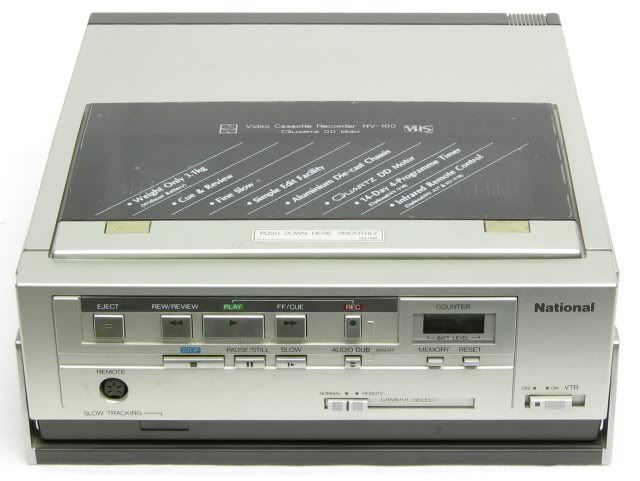
Back to the early 80's and in 1983, we acquired a portable Panasonic VHS video recorder and a Video Camera. This was a few years before camcorders took over. It was big and bulky and you had to make sure you didn't trip over the cable linking the camera to the recorder. You couldn't superimpose images from another video source or do stop motion animation (as you could on the Super 8 film camera). But being videotape, it had a very important feature that our 8mm set-up didn't have. An Audio Dub button.
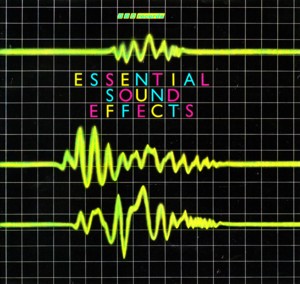
When I moved into high school, my weekends were spent making movies with this system. Occasionally with my friends, but mainly with re-purposed Star Wars figures (and whatever figures at the correct scale that you could get before Masters of the Universe up-sized action figures). At some point, I wanted to start adding sound effects and that's when I purchased this vinyl album in 1984
Well that and the fact I had become a Doctor Who fan (i.e. nerd) and I looked at anything Doctor Who-related. But this particular purchase ended up being useful and I soon looked to ways to integrate sounds from this disc into my movies. I learned that this album was number 19 in the BBC Sound Effects library. I smell a collection.
In the 80's, you could go and buy sound effects albums to use in plays and home movies. You still can now but in the record stores where I lived, the easiest and most comprehensive series of FX discs available to ordinary consumers were the BBC Sound Effects library.
I started with the Science-Fiction based sounds originally but as I branched out into more live action stuff, I needed a wider variety of effects. I did occasionally get one or two non-BBC discs but with few exceptions was disappointed by them. I did have a "Doctored for Super-Sound" disc that had some great military sounds on it.


Between 1984 and 1988, I had collected the majority of the library, even occasionally double dipping and getting some on cassette. I learned you got better quality by connecting a record player directly to the cassette recorder's audio input (back when audio input and output sockets and recording volume controls were common. DIN pin FTW) and indeed, connected the cassette players output into the VCR and using the microphone input on the cassette player to mix in dialogue. I eventually added a small radio shack mixer so that I could mix multiple tape decks at the same time. I used to also put a lot of effort int the video side but the sound work was the thing that eventually lead me into a career. A need trick was getting double speed sound effects in a high-speed dubbing two-deck unit by keeping the recording side deck open and holding down a toggle so that you fooled the deck into thinking it was recording.

That's not to say these sounds are the best sounds you could use at the the time. They were decent, they were familiar is you watched a lot of BBC-made programmes like The Goodies, Doctor Who, Blake's 7 and even some non-BBC series such as Danger Mouse. The Doctor Who sound effects album was used quite extensively on the original Transformers cartoon.
Stereo was still not ubiquitous for music even by the late seventies and so some of these albums were almost demo-discs for people's up-scale Hi-fi systems. BBC Records started to present some of these albums as almost sequences so the likes of "More Death and Horror" were little horror sketches than individual sounds. This made them less useful in the long run but occasionally you'd find something worth using.
Yes, it has the Liberator on it
since it featured sounds from Blake's 7, Hitch-Hiker's Guide to the
Galaxy (radio series) and some early 80's Doctor Who episodes.
Most
of the SF- oriented sounds in this series of discs were produced by the
BBC Radiophonic Workshop but most of the others created by sound
editors working on programmes. You couldn't buy sound effects from Star
Wars or Hanna Barberra cartoons and it would be a few years before there
was a disc of sounds from Classic Star Trek.
I used to watch movies and TV like other kids, but I started noticing the sounds more and more. I started noticing that on some American TV shows, every time someone opened a car door, it was the same sound or even funnier, the same explosion sound repeated over and over (See posts on Battlestar Galactica). We still have sound editors who use the same sounds over and over. Oh boy, If had a dollar for everytime someone uses the 'squeaky door' sound effect.
My interest in sounds morphed into an interest in music and for a few years I was away from film-making and sounds and just working on music. I did take on a sound engineering course in the early 90's, which gave me a good grounding as I moved into music work.
When multi-track recorders at home meant either Tracker software on the Amiga (Where I wrote my first professional commission for a video game) or a 4-track cassette recorder from Fostex or Tascam.
I had a Tascam 424 which I used to sync up to a Kawai Q-80 hardware sequencer for music. The way it used to sync up was by generating a tone called FSK (Frequency Shift Key). You had to sacrifice one of the four tracks to record the sync track (which was an awful sound similar to the tone a fax machine makes over the phone line) but what this meant was that you could play the 424 and when the recorded tone kicked in, the Q80 would start the song so your MIDI instruments would start playing in time (hopefully) with your three recorded audio tracks on the tape.You'd always have to start the song from the beginning, though you could 'drop in' if you were dextrous or had a foot-pedal.
In terms of sound effects, it also had a variable playback speed which with I used a great deal in my early sound work to take sounds recorded on tape and manipulate them before mastering onto either a cassette, or later on, minidisc. Later on I started working FX using a computer, initially in Animator Sound Lab and then Sound Forge, which I still use to this day.
Now, onto the Classic Sound FX...